

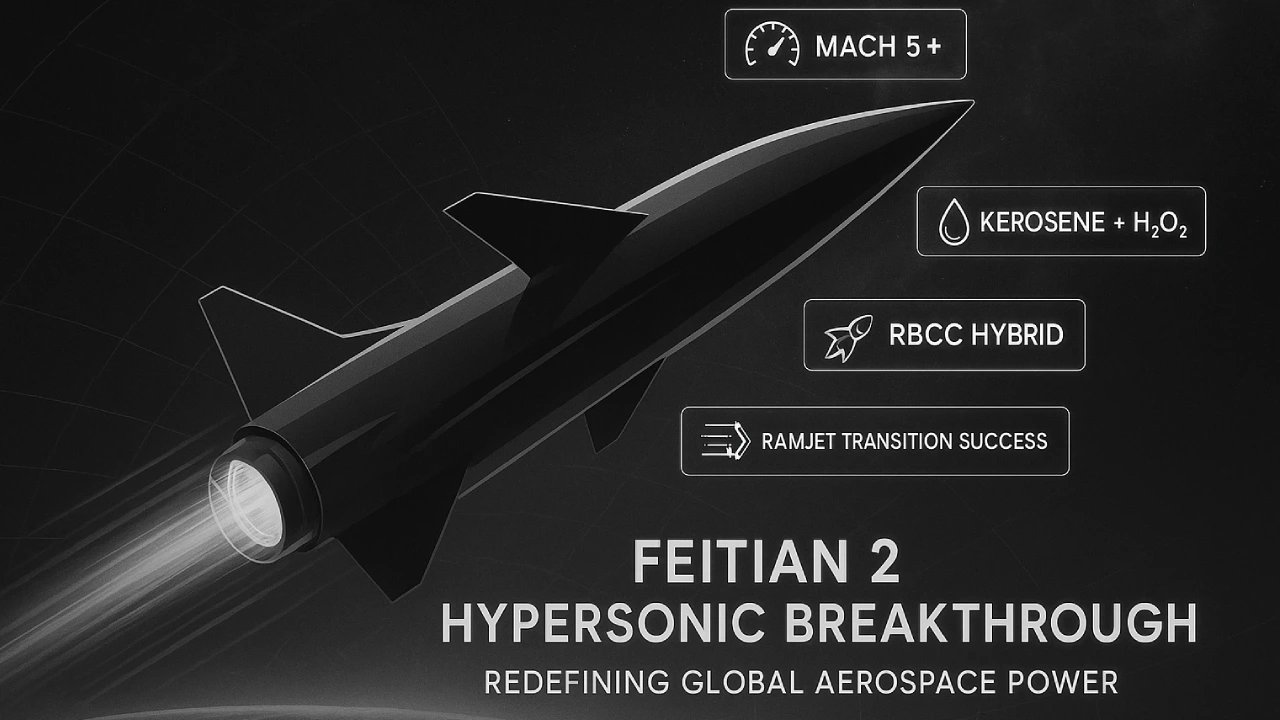
China Feitian 2 is making headlines again—this time for a jaw-dropping technological breakthrough that could redefine the future of global aerospace dominance. The Feitian 2 hypersonic test flight has stunned the world with blistering speeds, revolutionary engine design, and seamless in-flight transitions.
Developed by China’s Northwestern Polytechnical University (NPU), Feitian 2 represents the next generation of hypersonic vehicles and is already being seen as a game-changer in both aerospace technology and military strategy.
What is Feitian 2?
The Feitian 2 is a hypersonic vehicle built to travel at speeds greater than Mach 5—five times the speed of sound. Designed for cutting-edge research and national defense objectives, it has now officially entered the spotlight after a successful test flight conducted in northwestern China.





The Feitian 2 is powered by a Rocket-Based Combined Cycle (RBCC) engine, a futuristic propulsion system that combines rocket and jet technologies for maximum speed and efficiency.
Highlights of the Feitian 2 Hypersonic Test Flight
During its recent hypersonic test flight, Feitian 2 showcased a series of technological firsts:
- Seamless Mode Transition: One of the biggest hurdles in hypersonic propulsion is switching between rocket and jet modes mid-flight. Feitian 2 achieved this transition—specifically from ejector mode to ramjet mode—with surprising smoothness.
- Innovative Fuel Choice: The RBCC engine used a unique kerosene-hydrogen peroxide propellant. This not only improved fuel efficiency but also significantly reduced vehicle weight, allowing greater payload capacity.
- Enhanced Aerodynamics: Structural changes such as larger tail fins and new wings gave Feitian 2 improved stability and control while flying at hypersonic speeds.
- Autonomous Flight & Data Collection: The test flight included features like thrust-varying acceleration and fully autonomous flight, which allowed researchers to gather crucial performance data.
What Makes Feitian 2 Special?
Unlike traditional aircraft engines, the RBCC engine used in Feitian 2 leverages atmospheric oxygen, meaning it doesn’t need to carry as much onboard oxidizer. This drastically reduces launch weight while increasing fuel efficiency—a critical factor for long-distance, high-speed travel.
This design also allows the vehicle to operate in multiple flight modes:
- Ejector Mode for takeoff
- Ramjet Mode for mid-flight acceleration
- Rocket Mode for higher altitudes and maximum velocity
The ability to switch seamlessly between these modes is what makes Feitian 2 a standout in hypersonic engineering.
Why This Matters to the World
The successful Feitian 2 hypersonic test flight signals a major shift in the global aerospace race. With its efficient fuel system, high stability at extreme speeds, and autonomous flight capability, Feitian 2 could pave the way for:
- Advanced military vehicles
- Ultra-fast intercontinental travel
- Reduced satellite launch costs
- Next-gen aerospace exploration missions
Moreover, the project brings global attention to China’s increasing capabilities in aerospace innovation, likely pushing other major players to accelerate their own hypersonic programs.
Feitian 2 vs Previous Hypersonic Vehicles
| Feature | Feitian 2 | Older Hypersonic Vehicles |
|---|---|---|
| Engine Type | Rocket-Based Combined Cycle (RBCC) | Traditional Ramjet / Scramjet |
| Fuel | Kerosene + Hydrogen Peroxide | Liquid Hydrogen or Jet Fuel |
| Mode Transition | Seamless (Ejector → Ramjet) | Limited or manual |
| Flight Control | Autonomous | Partially manual |
| Payload Capacity | Increased (lighter design) | Heavier, less efficient |
Final Thoughts
The Feitian 2 hypersonic speed and its record-breaking performance are more than just headlines—they mark the beginning of a new era in global aerospace competition. Whether used for military defense, space exploration, or ultra-fast travel, Feitian 2 has put China at the forefront of hypersonic innovation.
As nations race to dominate the skies at hypersonic speeds, the successful test of Feitian 2 may well be remembered as a pivotal moment in 21st-century aerospace history.